
AGATHE SIMON
Celestial Attraction
3-channel documentary
4K single-channel or 3 HD screens, 5.1 or stereo, 14’59, 2026
© Agathe Simon


Download the full project presentation
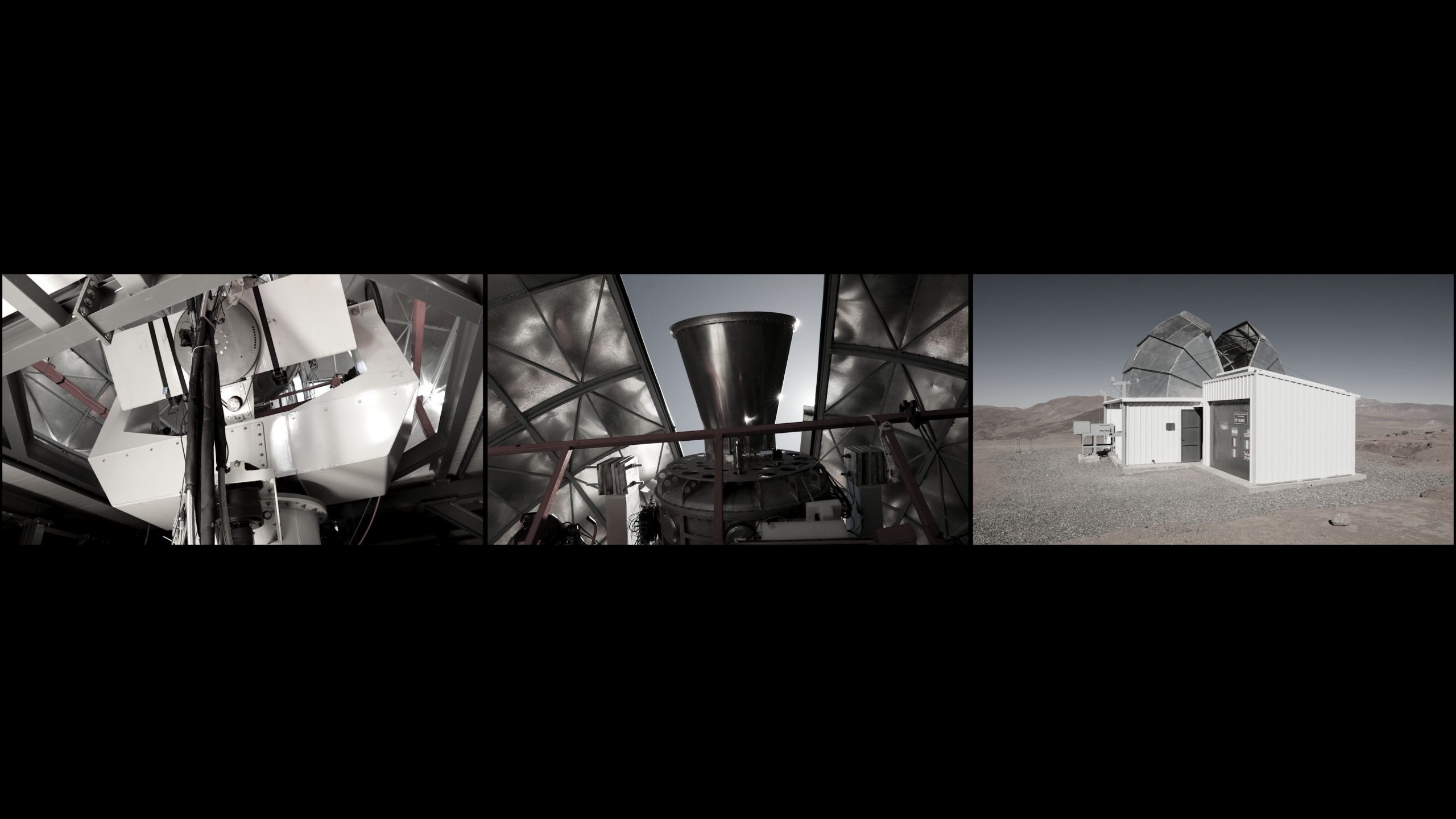
At an altitude of 5,000 meters (16,400 feet), in an Argentine desert where a new telescope rises, a cosmologist and a llama herder embody two contrasting visions of the creation of the universe.
Yolanda, a Kolla llama herder, holds a deep faith in God and in Pachamama (Mother-Earth). Beatriz, a cosmologist of European origin, leads the Argentine team operating the QUBIC telescope, installed on Yolanda’s land. Everything seems to set these two women apart. Yet Yolanda and Beatriz come together during a Pachamama ceremony at the foot of QUBIC.
Celestial Attraction is a 3-channel documentary built on fragmented sequences and desaturated images, revealing both the austerity of the desert and the partial nature of all human knowledge. By focusing on the stories and rituals of these two women, the film unfolds a dialogue between science, tradition, and the quest for the unknown.
Celestial Attraction is part of the Ex Nihilo cycle. It can be presented alongside the lecture-performance Imaging the Unknown as part of a 90-minute event featuring cosmologist Jean-Christophe Hamilton and artist-researcher Agathe Simon.
Credits
Direction: Agathe Simon
Production: Anne Rannou-Gillot & Étienne Roussel | The Group
In association with: Arielle Gillot-Rannou, Sébastien Lemaire, Viviane Monel-Villa
Cinematography & sound, original score, postproduction: Agathe Simon
Additional Sound (Pachamama): Mauricio Maori
5.1 and stereo mix: Mireille Faure
Subtitles: Denise Cobello