

AGATHE SIMON
Imaging the Unknown
A lecture-performance by cosmologist Jean-Christophe Hamilton and artist-researcher Agathe Simon
90′, 2026
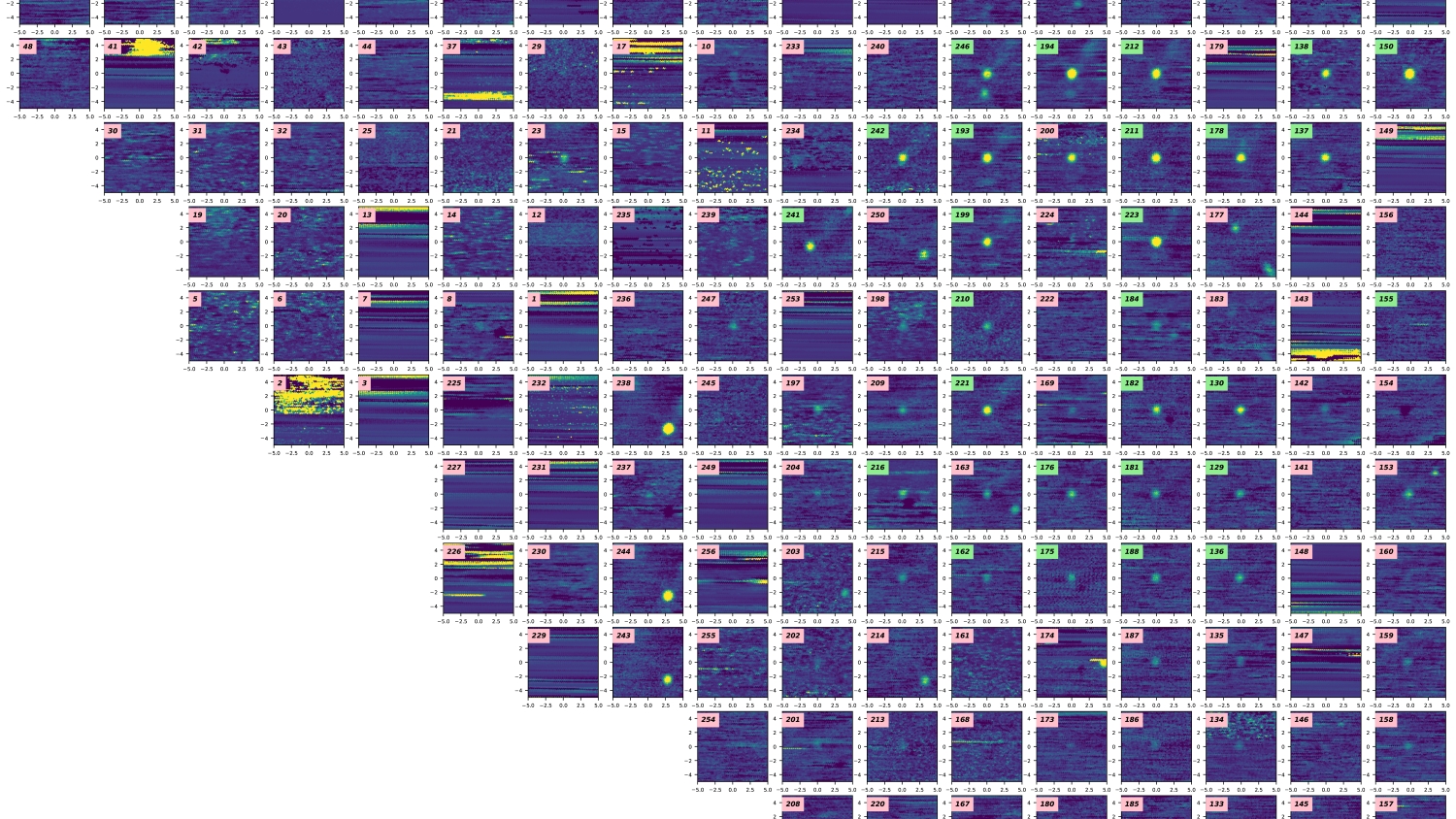
Photo credit: images generated by the QUBIC telescope © QUBIC collaboration
Imaging the Unknown is a lecture-performance (90 min) by artist-researcher Agathe Simon and cosmologist Jean-Christophe Hamilton. This event invites the audience to explore a question shared by art and science: How can we create images of the unknown?
For six years, the cosmologist and the artist-researcher collaborated on the creation of Celestial Attraction, filmed at the foot of the QUBIC telescope in a high-altitude desert in Argentina. Jean-Christophe Hamilton is the principal investigator for this telescope, designed to make visible the very first moments of the universe using revolutionary technology. Agathe Simon has explored, through a 3-channel documentary, the sensory forms assumed by the unknown within this territory.
Beginning with a screening of Celestial Attraction (14’59), this lecture-performance explores the processes through which images—both scientific and artistic—are created in an attempt to reveal the unknown, particularly the origin of the universe. At the heart of this lecture-performance lies “philagnosty,” a concept coined by Agathe Simon to denote the love of the unknown. This notion serves as the guiding thread of a two-voice narrative that weaves together scientific hypotheses, artistic creation, research processes, and tales of exploration. Together, the cosmologist and the artist-researcher invite the audience to experience this philagnostic approach and, in turn, to explore the paths that lead from the unknown to its representation.
This project is part of the Ex Nihilo cycle.

Scientific Partners
This project was developed in partnership with the Astroparticle & Cosmology Laboratory (APC) led by the University of Paris, the CNRS, the DIM-Origines of the Île-de-France region, and the ANR. It was also developed in partnership with the INFN in Italy and the Institute of Detection and Astroparticle Technology (ITeDA) in Argentina, led by the National Atomic Energy Commission (CNEA), the National Scientific and Technical Research Council (CONICET), the University of San Martín (UNSAM) and the UTN Mendoza.